Ad / Affiliate disclosure: This article contains affiliate links. If you make a qualifying purchase through these links, I earn a commission at no extra cost to you. All opinions are my own.
There's something quite satisfying about using a watch famous for going to the Moon to time something as ordinary as boiling an egg. I've used my Omega Speedmaster Professional for timing workouts too, and I still enjoy pressing that top pusher and watching the chronograph hand spring into action.
But this Speedmaster is particularly special to me for another reason. My wife bought it for me to celebrate the birth of our first child. Eight years later, it's still in my collection and still a watch I really enjoy wearing.
Mine is reference 311.30.42.30.01.005, the 42mm Moonwatch with a domed Hesalite crystal, steel bracelet and hand-wound Calibre 1861. It's the generation I originally reviewed in 2020, and one that remains an interesting option if you're considering a pre-owned Moonwatch alongside the newer 3861.
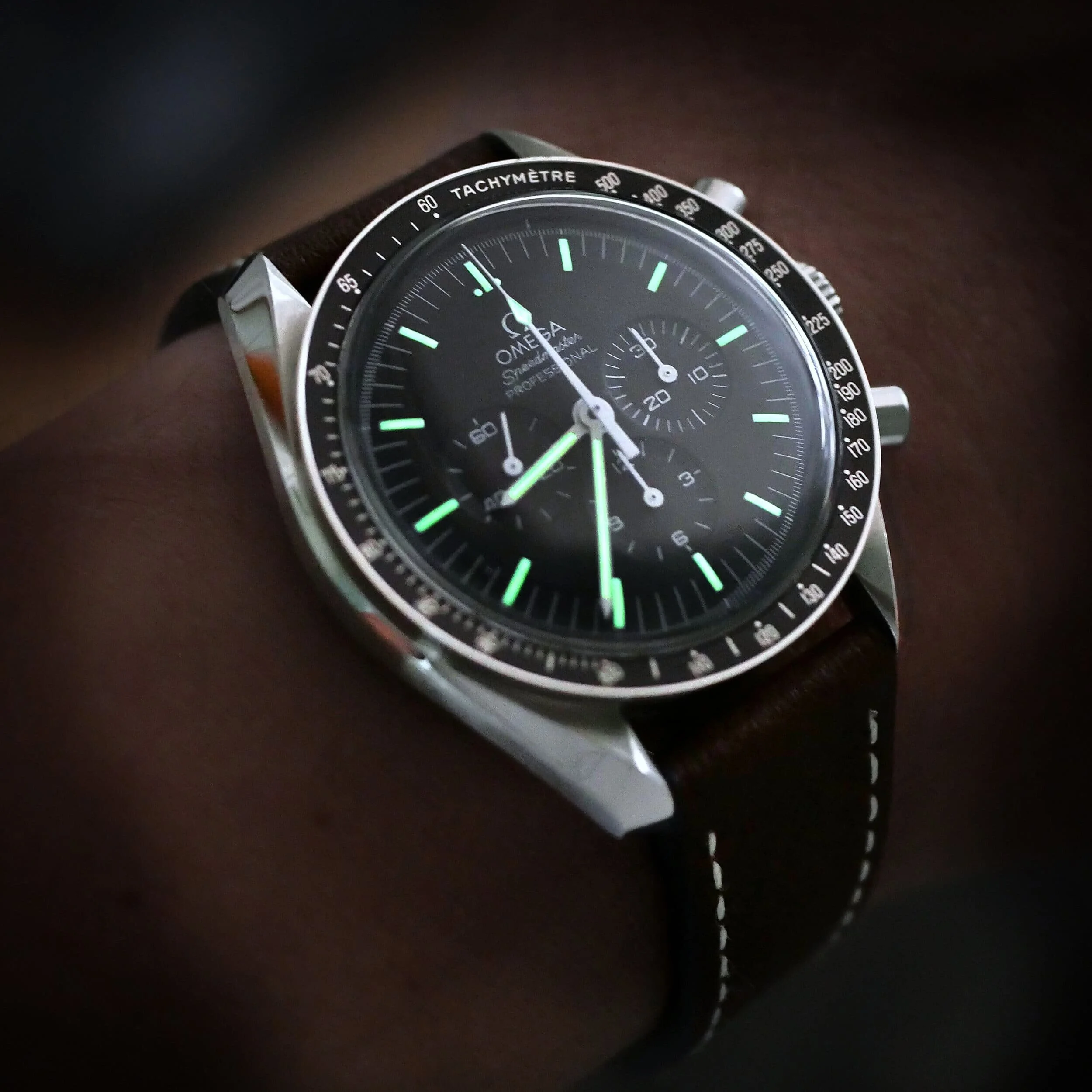
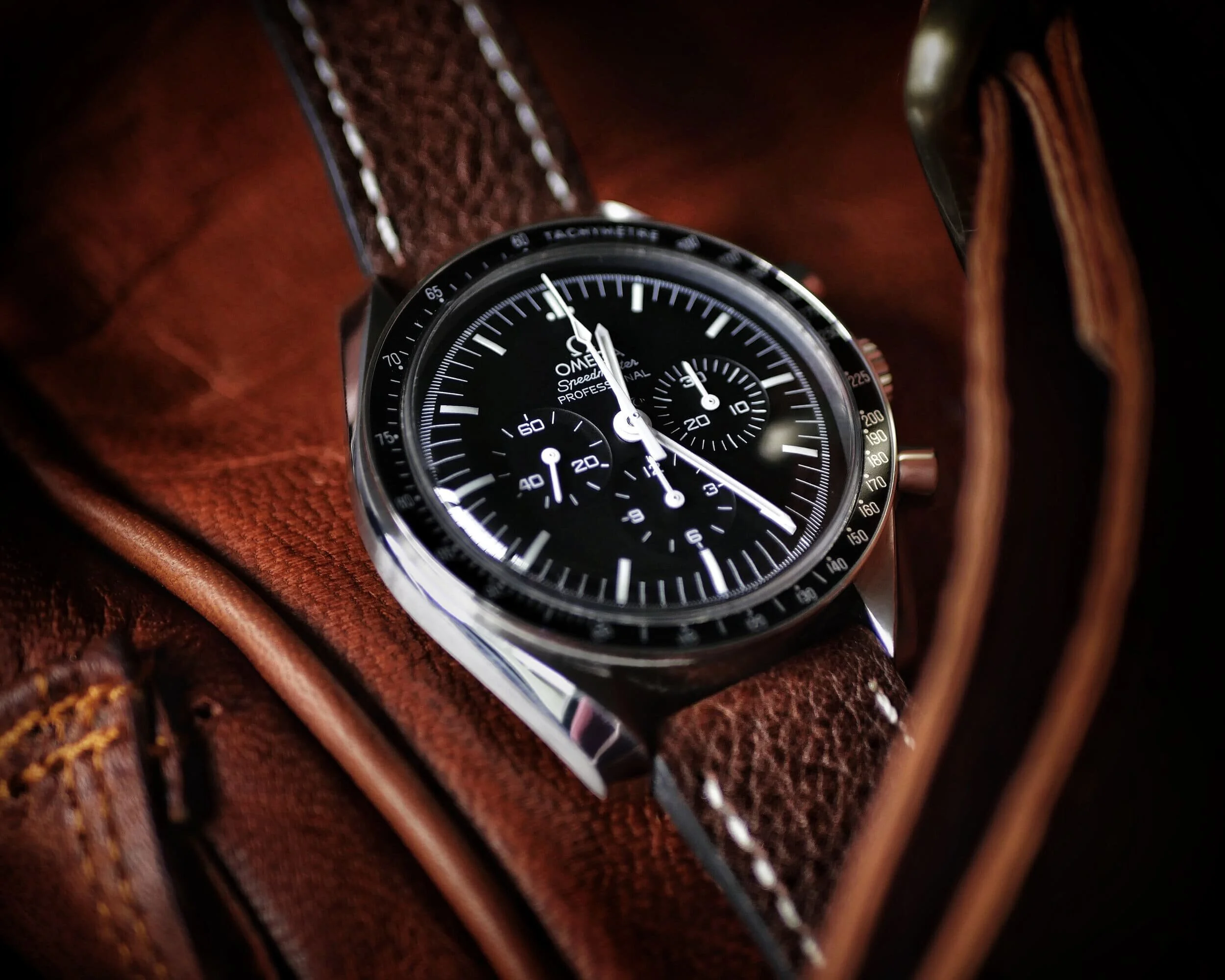
A racing watch with the Moon on its caseback
You can see what Omega originally had in mind for the Speedmaster by looking at the scale around the bezel. Back in 1957, this was a chronograph for sport and motor racing. Start it as a car passes the beginning of a measured mile and stop it at the other end. Wherever the long white hand finishes, the number beside it on the bezel gives you the car’s average speed in miles per hour. It works just as well over a kilometre if you’d prefer the answer in kilometres per hour. Once you know what those numbers do, the racing connection is quite easy to see.
It’s the space connection that most of us know, though. NASA qualified the Speedmaster for crewed space missions in 1965, the year Ed White made the first American spacewalk. Four years later, Buzz Aldrin wore a Speedmaster on the surface of the Moon. The watches that went to the Moon used Omega’s Calibre 321, an earlier relative of the 1861 in mine. There’s more on that part of the story in my history of Omega.
I’ve always liked how easy that bit of watch history is to share. Someone who has very little interest in movements or chronographs can still appreciate what it meant to land on the Moon. Turn my Speedmaster over and there’s the story in a few lines of engraving, with Omega’s hippocampus in the middle of the steel back. I like the simplicity of it. There’s plenty to enjoy on the front of the watch, and something worth turning it over for as well.
How the 42mm Speedmaster wears
If you like the Speedmaster but 42mm sounds a bit big, do try one on. I get on very well with the size of mine, and the short lugs are a good part of the reason. In a straight-on photograph your eye tends to go to that broad black bezel. On the wrist, what I notice is how soon the lugs end and the bracelet can start to come around my wrist. The dial has plenty of room, which I appreciate on a chronograph, without the ends of the case stretching out as far as you might expect.
Those twisted lugs are among my favourite details on the whole watch. There’s fine brushing on the steel and a polished edge that follows the twist, so as you turn your wrist you can see exactly where one finish gives way to the other. It shows up particularly well in the photograph on brown leather. With the bracelet off, you get a lovely clear view of the shape of the case.
The steel bracelet is very well made, but I’m glad Omega went with 20mm between the lugs. It’s my favourite width for the simple reason that finding straps is so easy. I think the Speedmaster looks fantastic on brown leather, and the striped fabric strap in the later photograph gives it a much more casual feel. You can have a fair bit of fun with straps on a watch this straightforward in colour. The plain black NATO that came in the box is a good place to start.
The dial through Hesalite
Chronographs can get busy quite quickly. What I like about the Speedmaster is that I can glance at it for the time and then, if I want to time something, there’s a whole second set of information that’s just as easy to follow. All three little subdials are black, the same colour as the main dial. It’s the white hands and markings that stand out, and keeping the colours that simple leaves the face remarkably clear.
The little hand at nine o’clock is the one you’ll normally see ticking away. The long white seconds hand in the centre belongs to the chronograph, with elapsed minutes at three o’clock and hours down at six. After dark, it’s the luminous hour markers and the hour and minute hands that catch your eye. The lume photograph gives you a good idea of how much of that familiar dial you can still recognise with the lights down.
One of my favourite things about the Hesalite crystal is how it changes the appearance of the dial depending on the angle. Straight on, the white printing looks crisp against the black. As you tip it away, the curve of the Hesalite starts to pull the markings out of shape around the edge. Catch it in the right light and there’s a lovely warmth to the dial that’s a big part of why I like this version. It’s also why I don’t mind giving the crystal a little attention.
When I first reviewed mine, I’d give the crystal a light polish with Polywatch every few months. Hesalite is acrylic, so it’ll pick up fine marks more readily than sapphire, but a few minutes was usually enough to clear the ones I’d picked up. A deeper gouge is another matter. If you’re choosing between the two crystals, I’d try to see them side by side and look across the dial as well as straight through it. Sapphire’s extra scratch resistance is appealing. Having lived with the Hesalite, though, I’d happily choose it again.
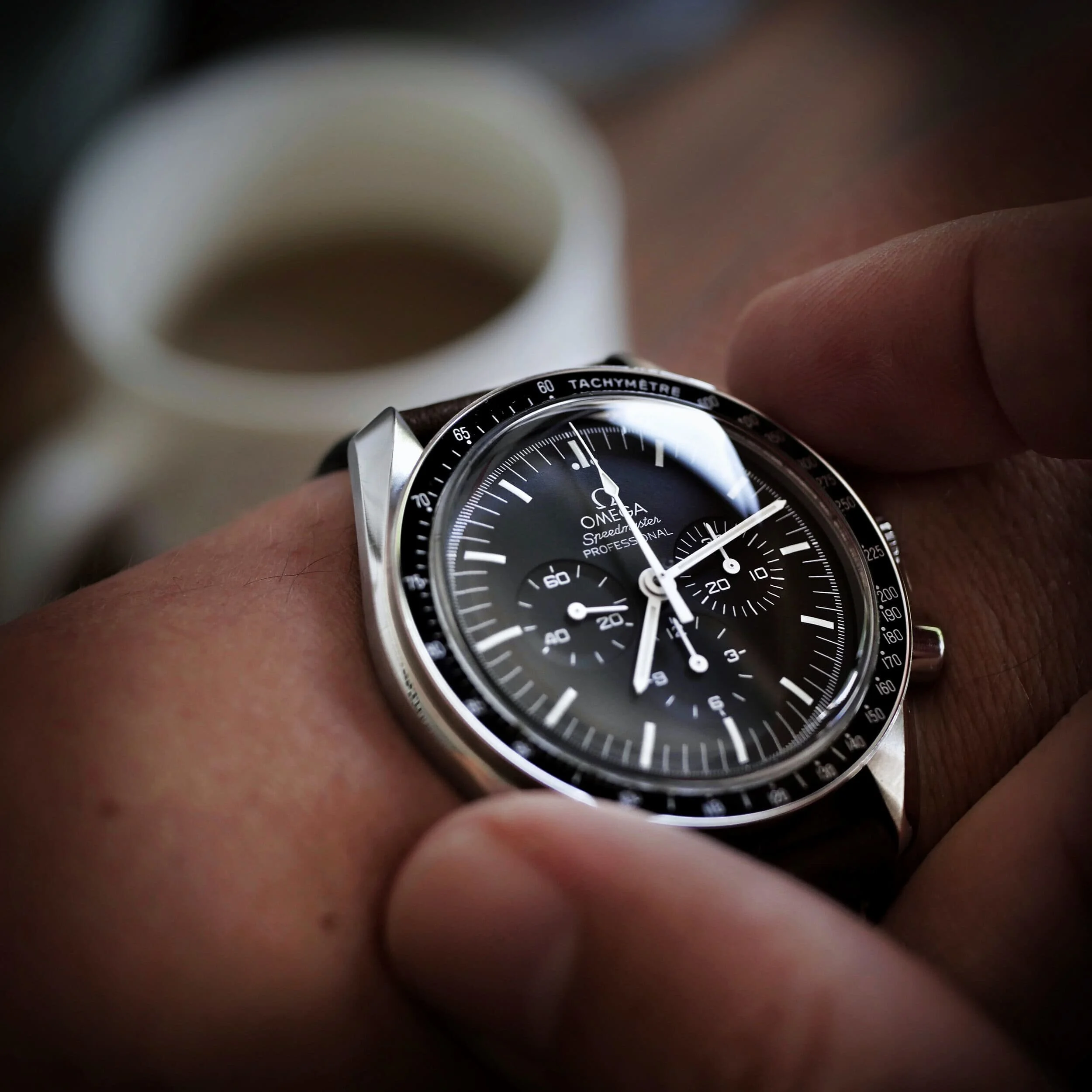
Always perfectly legible
Winding the 1861 and putting it to work
The Calibre 1861 needs winding by hand, and that was one of the attractions for me. A full wind gives a quoted 48 hours of running time, so there’s enough in reserve that you don’t have to get the crown between your fingers at precisely the same time every day. I tend to settle into winding it in the morning or the evening. I enjoy having that little bit of time with the watch, and it does occasionally cross my mind that winding a Speedmaster was once part of somebody’s day on the way to the Moon.
The pushers are another part of the watch I get a lot of enjoyment from. The top one has a satisfying action as you press it to set the long seconds hand going. Press it again to stop, take your reading, then press the lower one to send the chronograph hands back to their starting positions. For the egg on the hob, the little 30-minute counter is all I need to look at. For anything longer, the lower register keeps count for up to 12 hours. It’s a useful complication, and I suspect I’d use it less often if it weren’t quite so nice to operate.
For everyday wear I’ve been happy with the Speedmaster, although it wouldn’t be my choice for a day spent swimming. Omega rated this generation to 5 bar, or 50 metres, when new. If you’re looking at a pre-owned one now, I’d want to know when that particular watch last passed a pressure test. The original figure tells you what Omega built it to do. The condition of the seals matters rather more once it’s had a few years on someone’s wrist.
The Calibre 1861 vs 3861
Omega introduced the Calibre 3861 to the standard Moonwatch Professional in 2021. You still wind it by hand, and the quoted reserve went up from 48 to 50 hours. A difference you might appreciate more often is what happens when you pull out the crown to set the time. On the 3861 the running seconds stop, which makes it easier to line the watch up precisely with a time signal.
There’s more going on inside the newer watch, including Omega’s Co-Axial escapement and Master Chronometer certification. That includes testing the completed watch for accuracy and resistance to magnetism. Side by side, the revised bracelet and the little step around the outside of the newer dial are easier differences to spot. Both generations were offered with Hesalite, so if it’s the steel-bracelet version I own that you’re after, 311.30.42.30.01.005 is the reference to look for. If you’d like to see how the two compare on price, you can check prices for the newer Hesalite Moonwatch on eBay.
The original Moonwatch presentation box
One thing I’d pay attention to in a listing is what the seller means by a full set. Mine came with the large Omega flight-style presentation box and all its original accessories. There’s a plain black NATO with steel hardware, a tool for changing the strap and a long Velcro strap based on the astronaut version, complete with the mission-style markings. I like that Omega gave you both. The Velcro strap is a lovely thing to have with a Moonwatch, while the black NATO is something you can put straight on if you fancy wearing the watch a little more casually.
There’s also a loupe with a tachymeter scale around the glass, a hippocampus paperweight, the instructions and a book about the missions. The book deserves a mention of its own. The photography is lovely and it’s well worth sitting down to read. Opening that case, you can see why the whole presentation appealed to me. Between the book and that long strap, there’s quite a bit of the history there to enjoy even after you’ve put the watch on.
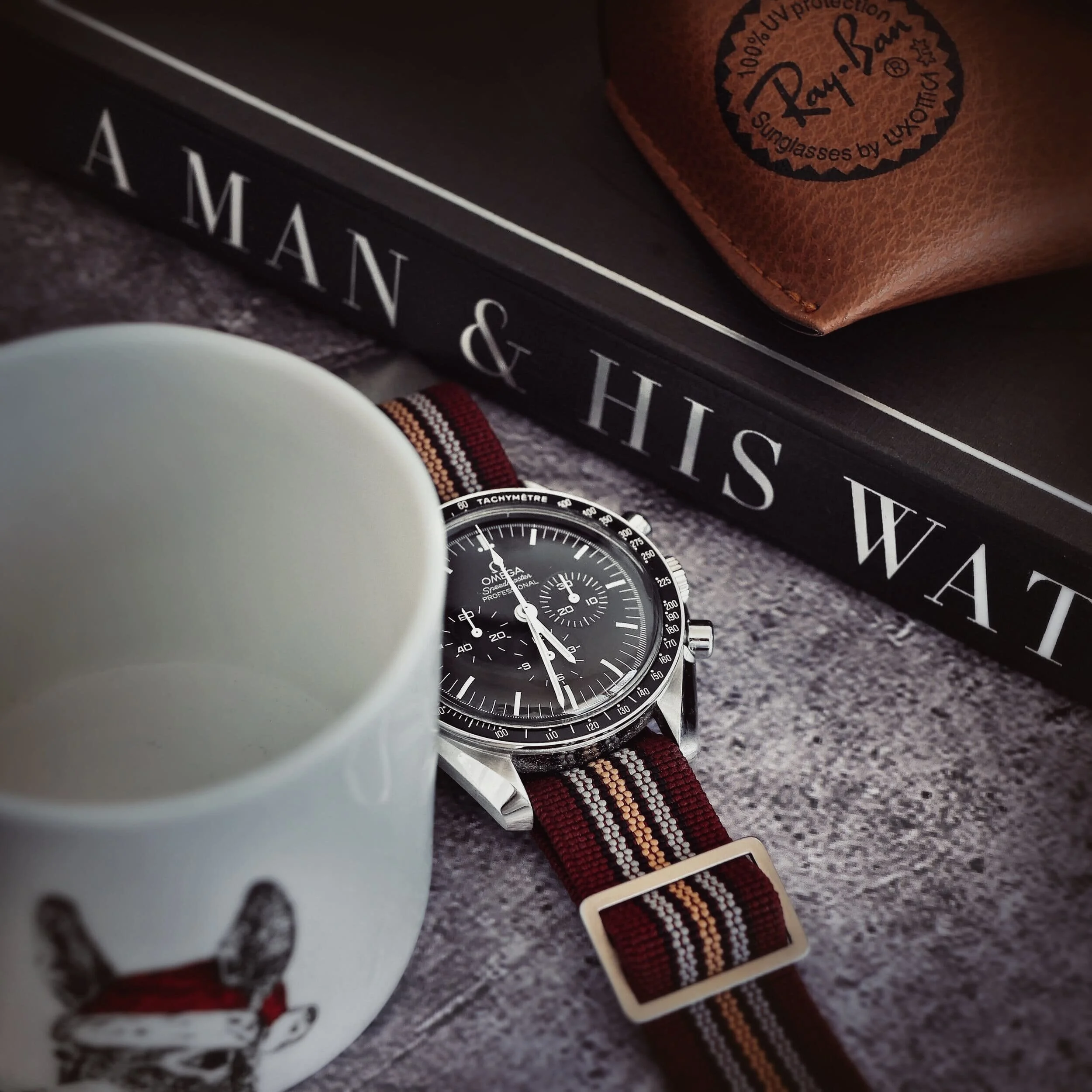
The Speedmaster works well with a variety of straps
If the set is part of the appeal for you too, ask for a photograph of what’s actually included. I’d want to know the service history and see that the chronograph starts, stops and resets properly as well. Those details are worth keeping in mind when you compare pre-owned Speedmaster Professional 1861 prices on eBay. Two listings can carry exactly the same reference and offer quite different things for the money.
Omega Speedmaster Professional 1861 specifications
| Detail | Watch reviewed |
|---|---|
| Model | Omega Speedmaster Professional Moonwatch |
| Reference | 311.30.42.30.01.005 |
| Case | Stainless steel, 42mm diameter |
| Lug width | 20mm |
| Dial | Black with three black subdials, white markings and luminous hands and hour markers |
| Bezel | Fixed black tachymeter bezel |
| Crystal and caseback | Domed Hesalite crystal and solid engraved steel back |
| Movement | Omega Calibre 1861, hand-wound mechanical chronograph |
| Power reserve | 48 hours quoted |
| Chronograph | Central chronograph seconds, 30-minute and 12-hour counters |
| Bracelet | Stainless steel |
| Original water-resistance rating | 5 bar / 50 metres |
Eight years with my Speedmaster
I still think the Speedmaster gets the basics of a racing chronograph very right. The white hands are easy to pick out against the black dial, the short lugs help that 42mm case sit well, and the pushers feel good every time I use them. If it’s that racing look you’re drawn to, my Timex Q Chronograph review is another one you might enjoy. On the Omega, my favourite detail is still the way the markings curve away at the edge of the Hesalite. Even after eight years, I enjoy turning my wrist to catch it.
When I first wrote about my Speedmaster in 2020, I said it was a watch I intended to keep. Eight years later, I feel exactly the same. My wife bought it for me to celebrate the birth of our first child, so it will always have a special place in my collection. But beyond that personal connection, it's a watch I genuinely love wearing. Other Speedmasters might catch my eye, but this is the one I want to keep.