

Ad / Affiliate disclosure: The watches featured here were loaned by NOMOS. This article contains affiliate links. If you make a qualifying purchase through these links, I earn a commission at no extra cost to you. All opinions are my own. As an Amazon Associate I earn from qualifying purchases.
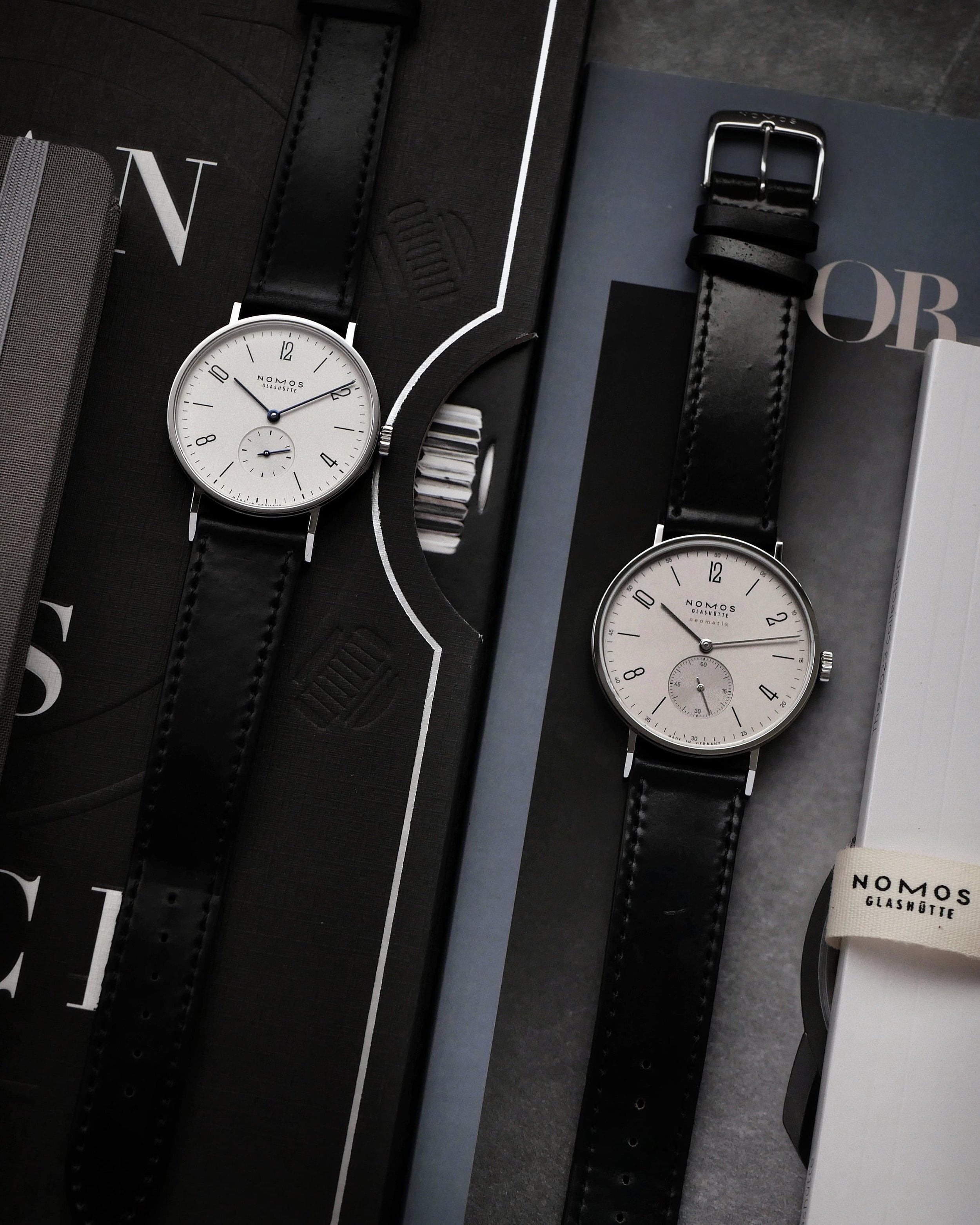
I thought choosing between these two Tangentes would be fairly straightforward. I love a hand-wound watch, and the classic 35mm model feels immediately at home on my wrist. Then I put on the Neomatik 39 with its platinum grey dial, and the decision gets a little harder. There's something about that slightly larger size and grey dial that really appeals to me, even though the smaller watch has the winding experience I enjoy so much.
I've spent time wearing both, and neither feels like the wrong size on my wrist, which is just over seven inches. They're recognisably the same design, but the difference is about more than a few millimetres. The white-dial Tangente is the simpler, hand-wound option; the grey Neomatik brings automatic winding and a little more presence. If you're trying to choose between them, those are the differences worth spending some time with.
Which Tangentes are we comparing?
The smaller watch here is the 35mm Tangente with the Alpha hand-wound movement and a sapphire display back: reference 139. You'll often see it discussed alongside the 101, which has a solid steel back. They share the familiar white silver-plated dial and blue hands, but they aren't interchangeable references if seeing the movement matters to you.
The larger watch is the Tangente Neomatik 39 platinum grey, reference 144. Despite the name, its case measures 38.5mm across. It uses NOMOS's DUW 3001 automatic movement, also visible through a sapphire back. This isn't a comparison between the white and grey versions of the same automatic watch: the smaller Tangente has a different movement as well as a different size and dial.
There's one detail to watch when shopping today. NOMOS now lists the 139 with its newer DUW 4001 hand-wound calibre and up to 53 hours of power reserve. The watch in my photographs has the earlier Alpha, quoted at up to 43 hours. My comments about winding and wearing it come from that watch, so check which movement a listing actually offers, particularly when comparing new and pre-owned examples.
The same design, with two different characters
The Tangente does a lot with very little. A narrow bezel leaves plenty of room for the dial, the long hands reach out towards the markings, and those distinctive numerals give it a personality of its own. The small seconds sits at six without a date window competing for attention. It's simple, but it certainly isn't anonymous. If you'd like more background on the company, my NOMOS Glashütte article explores the brand beyond these two watches.

On the 35mm, I really like the combination of the white silver-plated dial and tempered blue hands. The blue gives you something to enjoy without adding another colour across the whole face, and the fine circular pattern in the seconds subdial breaks up the otherwise clean surface. There's no need for a busy dial when the shapes and proportions are doing this much already. It's easy to see why this is the version people picture when somebody mentions a Tangente.

The platinum grey Neomatik keeps those familiar shapes but changes the feel of the watch. The dial and hands are rhodium-plated; the name doesn't mean you're getting a platinum case or a solid platinum dial. The hands have a silver tone instead of the smaller watch's blue, and there's a little extra detail in the numbered outer scale and the gold-coloured neomatik lettering. It still looks wonderfully clean, just a little more contemporary to me.
For me, the grey dial just has the edge. I find it really easy to read, and I love how it works with that slightly larger case. The photographs are useful here: the difference is much easier to appreciate than the colour names alone suggest.
Tangente 35mm vs 39: how they wear
The 35mm feels right as soon as I put it on. Those long, thin lugs are a big part of the design, and I think they suit it really well. I know they won't be to everyone's taste, though. They also explain why you shouldn't judge the fit from the diameter alone: the 35mm case stretches to 45mm from lug to lug, so it takes up more space along the wrist than that small diameter might suggest.

What surprised me was that the larger Neomatik suits me too. It has more dial to look at, but it keeps the slim case and narrow bezel that make the Tangente so distinctive. NOMOS currently gives the 144 a lug-to-lug measurement of 47.3mm and a thickness of 7.2mm. It's wider than the 35mm, certainly, but it doesn't suddenly become a thick, bulky watch. For my wrist, the extra size is something I enjoy rather than something I have to put up with.

Both have black Horween Shell Cordovan straps, which keep the attention on the watch itself. The strap widths differ, though: 18mm on the 35mm and 19mm on the Neomatik 39. That's worth knowing if you already have a collection of straps you'd like to use. The two watches don't take the same width, and the larger model isn't 20mm as you might expect.
I'd try both sizes if you can. My experience doesn't support a simple rule that the 35mm is only for small wrists or that a seven-inch wrist needs the 39. Both work for me. The smaller watch gives you the more compact look, while the larger one lets that broad, open dial take up a little more of your wrist.
Alpha vs DUW 3001: winding is part of the choice
The Alpha is a big part of why I enjoy the smaller Tangente. Winding it feels silky smooth, and I love that daily interaction with a watch. I enjoy the same thing with my Speedmaster Professional: taking a moment to wind it is part of the fun for me, rather than a job I'd rather avoid.

Turning the Tangente over gives you another reason to enjoy it. Without an automatic rotor covering part of the movement, you get a clear view of the striped plate, blue screws and winding wheels. The finishing on both watches really impresses me, and the display backs feel worthwhile. A watch this restrained from the front can still give you plenty to look at on the other side.
The Neomatik's DUW 3001 winds automatically as your wrist moves. That's useful if you'd prefer to put your watch on and get on with the day, although an automatic still needs enough wear to stay wound. Leave it off long enough and it'll stop, just like the hand-wound watch. Both of these movements have a quoted reserve of up to 43 hours, so automatic winding doesn't give this particular Neomatik a longer reserve than the Alpha.

What's particularly interesting is how little thickness the automatic mechanism adds. The DUW 3001 movement is only 3.2mm high, with a rotor that winds in both directions. It also uses the NOMOS swing system, the company's own escapement. You don't need to know every component to appreciate the result: the watch winds itself while keeping the slim shape that makes the Tangente appealing in the first place. The rotor adds something different to enjoy through the back, too.
Both ran well while I had them, although I didn't measure their accuracy closely enough to say which was better. For me, the choice is much more about whether you enjoy winding a watch, and how much you like the size and dial around the movement.
Specifications at a glance
| Detail | Tangente 35mm reviewed | Tangente Neomatik 39 platinum grey |
|---|---|---|
| Reference | 139; 101 is the steel-back alternative | 144 |
| Diameter | 35mm | 38.5mm |
| Thickness | 6.6mm, display-back version | 7.2mm on current model page; 2022 sheet lists 7.1mm |
| Lug to lug | 45mm | 47.3mm |
| Case | Stainless steel | Stainless steel |
| Dial / hands | White silver-plated / tempered blue steel | Rhodium-plated platinum grey / rhodium-plated |
| Crystal / caseback | Sapphire / sapphire display back | Sapphire with inner anti-reflective coating / sapphire display back |
| Movement reviewed | Alpha, hand-wound | DUW 3001, automatic |
| Quoted power reserve | Up to 43 hours | Up to 43 hours |
| Display | Hours, minutes and small seconds; no date | Hours, minutes and small seconds; no date |
| Strap / lug width | Black Shell Cordovan / 18mm | Black Shell Cordovan / 19mm |
| Water resistance | Original review records 3 atm; current 139 lists 5 atm | 5 atm |
The Alpha figures describe the earlier watch reviewed here, rather than today's DUW 4001 version. Dimensions are published specifications, not my own measurements. NOMOS describes its 3 and 5 atm watches as splash-proof and recommends taking them off for swimming; neither is the watch I'd suggest buying for time in the pool.

35mm manual wind Tangente

Price, value and choosing the right version
At the time of checking in November 2026, NOMOS lists the current display-back 139 at £2,080 and the Neomatik 39 platinum grey 144 at £3,460. That's a £1,380 difference, although the current 139 has the newer DUW 4001 rather than the Alpha I've worn. Those prices help explain where the two sit today; they aren't prices I paid, and older stock and pre-owned examples can be quite different.
I think the finishing is a real strength of both watches. The smaller Tangente gives you that distinctive design and a movement I really enjoy winding without spending Neomatik money. The 39 asks more for its slim automatic movement, larger case and different dial. Whether that's worthwhile depends on which parts you care about. Enjoying the Alpha isn't a compromise you have to apologise for, and preferring an automatic doesn't mean giving up an interesting movement to look at.
If you're browsing listings, check the reference, movement and caseback together. A 101 won't give you the display back shown here, and a 35mm automatic Tangente isn't the same watch as the 35mm manual. The retailer searches below cover the wider Tangente family, including other sizes and dial colours. Check condition, service history, seller warranty and any delivery or import costs as well as the headline price.

Side by side the 35mm and 39mm Tangente’s
My verdict: Tangente 35mm or Neomatik 39?
The grey Neomatik 39 just edges it for me. I really like its dial, the slightly larger size suits my wrist, and the finishing gives me plenty to enjoy when I turn it over. What makes the decision interesting is that I still want the winding experience of the smaller watch. The automatic wins me over as a whole, rather than because I think automatic winding is inherently better.
I wouldn't dismiss the 35mm without trying it, even if you're used to larger watches. It feels immediately at home on my wrist, and that simple white dial with blue hands has so much charm. If winding is something you look forward to, the smaller Tangente gives you a very good reason to keep doing it.
I've enjoyed seeing a different side of NOMOS in the Autobahn Neomatik, but these two make a lovely case for keeping things simple. I came away impressed by both, with the grey 39 just ahead. The fact that the 35mm still makes me hesitate tells you how much I like it too.