

Ad / Affiliate disclosure: The watch featured here was borrowed. This article contains affiliate links. If you make a qualifying purchase through these links, I earn a commission at no extra cost to you. All opinions are my own. As an Amazon Associate I earn from qualifying purchases.
The Rado DiaStar Original Skeleton certainly isn't shy. That broad, polished bezel, the unusual case shape and a movement you can see through the front give it quite a look. It's a bit blingy, and I mean that in a good way. There’s plenty of shine here, but I don't find it over the top.
The version in these photographs is the R12162153, with a silver-tone case and steel bracelet around an anthracite-grey skeleton movement. I've spent some time wearing it, and the comfort is one of the things I appreciate most. There's more to this watch than an interesting face, although that face gives you plenty to look at.
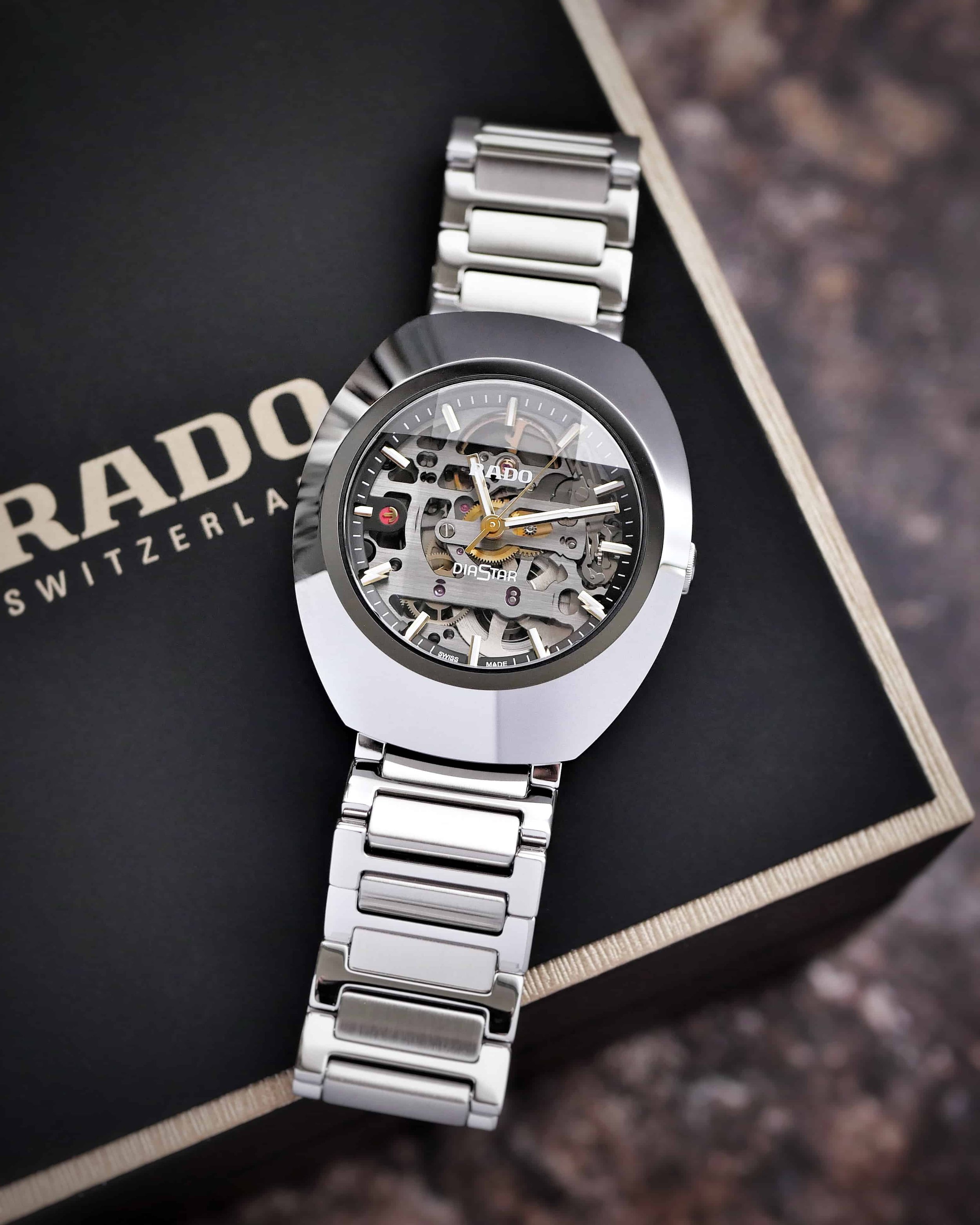
The DiaStar shape and Ceramos bezel
The shape is a big part of the appeal. There's a round opening for the dial, but the watch around it has that broad, oval outline, with the bracelet disappearing underneath at either end. It doesn't look like a conventional round watch with four lugs sticking out. The DiaStar design goes back to 1962, and that slightly futuristic look still gives it something different today.
The polished bezel makes the most of it. There's a lot of surface around the dial to catch reflections, so you get quite a contrast between the bright outer edge and the darker movement inside. It’s a shiny watch, but keeping the case and bracelet silver-tone stops it becoming a jumble of different colours. The small gold-coloured details are mostly kept within the dial.
Rado uses Ceramos for the bezel, a mixture of ceramic and metal that gives it good scratch resistance and that metallic shine. The middle case and bracelet are stainless steel, though, so you aren't getting Ceramos all the way around. The steel can still pick up marks, and I'd take care of the bezel too. Scratch-resistant doesn't mean you can knock it about without worrying.
What I do notice is fingerprints. That lovely polished surface is a bit of a magnet for them, which is one of the less glamorous parts of having so much shine around the dial. A soft cloth is worth keeping handy if you like it looking its best.
The skeleton dial and faceted sapphire crystal
There's a lot to enjoy in the skeleton dial. Instead of covering everything up, Rado lets you see the grey bridges crossing the face, with gears and other parts visible through the openings. The anthracite finish works really well with the small touches of gold. I like that Rado has kept the colours fairly simple, even with so much on show. The hands and hour markers stand out against the darker movement, and the black minute track around the edge gives you somewhere to read the time among it all.
I like the little details here, too. The hour markers appear to float over the movement, and the red-backed anchor at nine adds a small splash of colour. The Rado name sits beneath twelve, with DiaStar above six, and there's no date window taking up space. There's already so much going on beneath those hands that the dial really doesn't need much else.
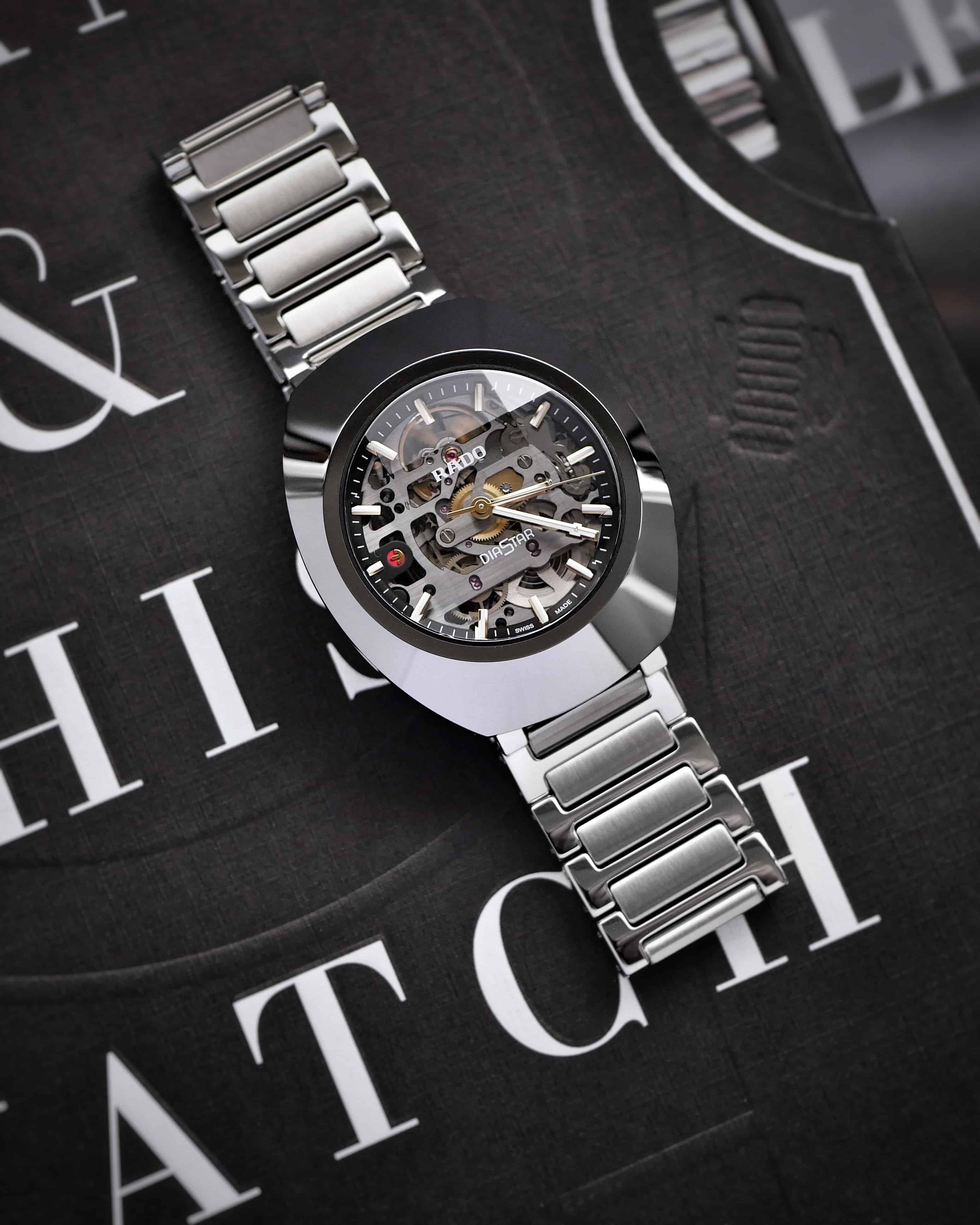
Then there's the sapphire crystal, which is quite a feature in its own right. The facets form a square over the round dial, with sloping sections around it. You can see the edges and reflections in the photographs, and they add to the slightly unusual look of the watch. A flat crystal would give you a simpler view, but this one gives the DiaStar something extra to look at. Between that square, the round dial and the oval case, Rado has certainly kept things interesting.
The hands and hour markers have Super-LumiNova, although there's still a lot behind them compared with a plain dial. If you're thinking of buying one, have a look from a few different angles and see how easily you can pick out the hands. The open movement is a big part of the fun here, but you'll want to be happy reading the time as well as looking at everything underneath it.

How it wears: the case and H-link bracelet
On my wrist, the DiaStar Original Skeleton feels really comfortable. The case and H-link bracelet work well together, and that's something I appreciate alongside the unusual looks. There's plenty to catch your eye, but the fit deserves some credit too.
Rado lists it at 38mm across and 11.9mm thick, but it's worth looking at the shape as well as those numbers. The bezel gives it a broad face, while the bracelet comes in beneath the case rather than hanging from long, exposed lugs. I'd still try it on if you're unsure. Knowing it's 38mm wide is helpful, but it won't tell you everything about how an oval watch like this will fit.
I like how the H-link bracelet suits the case, too. The mix of brushed and polished steel helps break up all that shine, and the broad links look right beneath the oval case. It's fastened with a three-fold steel clasp underneath. With so much attention drawn to the front of the watch, it's good to find a bracelet that looks the part and feels comfortable as well.

The R808 movement and 80-hour power reserve
Inside is Rado's R808 automatic movement, with a quoted 80-hour power reserve. That's a little over three days from fully wound, which is handy if you like swapping between watches. Put it down for the weekend with enough power stored and it should still be ticking when you come back to it. You do need a full wind to get the quoted reserve, though. A short spell on the wrist won't necessarily top it up completely.
The rotor winds the movement as you wear the watch, and there's sapphire front and back so you can see it from both sides. You don't have to turn the watch over to get a look at the mechanism, though. The bridges, gears and openings are right there beneath the hands, which is what makes this version of the DiaStar so different from one with an ordinary dial.
The R808 also has an antimagnetic Nivachron hairspring, which helps reduce the effect of magnetic fields on its timekeeping. Rado tests the movement in five positions, checking it at different angles. It's reassuring to know Rado does that, although it doesn't tell us exactly how accurate this particular watch is.
Rado DiaStar Original Skeleton specifications
| Detail | Specification |
|---|---|
| Reference reviewed | R12162153 |
| Case diameter / thickness | 38mm / 11.9mm |
| Listed weight | 133g |
| Bezel | Ceramos |
| Middle case / bracelet | Stainless steel |
| Front crystal / caseback | Faceted sapphire / transparent sapphire |
| Movement | Rado R808 automatic, skeletonised, anthracite-grey finish |
| Power reserve | 80 hours |
| Hairspring | Antimagnetic Nivachron |
| Manufacturer testing | Movement tested in five positions |
| Display | Hours, minutes and central seconds; no date |
| Lume | Super-LumiNova details on hands and indexes |
| Clasp | Three-fold stainless steel |
| Water resistance | 100m / 10 bar |
Dimensions, weight and movement details are from Rado's R12162153 specifications; the 100m rating is also listed by Mappin & Webb for this reference. These are published figures rather than my own measurements.

Value and buying the right DiaStar Skeleton
Rado currently lists the R12162153 at £1,900 in the UK, although it's worth shopping around as prices can vary quite a bit. For that money, I'd want to really like the way it looks. The 80-hour reserve is handy, but you don't have to spend this much to get one. It's the Ceramos bezel, that unusual crystal and the open movement inside the DiaStar case that give you more to think about here.
If you like retro steel-bracelet watches but prefer a more conventional dial, my Tissot PRX Powermatic 80 review is worth a look. The Citizen Tsuyosa Small Seconds takes another approach, with a textured dial and a separate seconds display. Neither gives you this view through the front of the watch. And really, that's a big part of the decision. Do you love being able to see the movement, or would you rather have a more traditional dial?
Check references carefully when browsing. The eBay search below covers the silver-tone R12162153 featured here and the gold-tone R12164153, both DiaStar Original Skeleton models. The Amazon US link is for the reviewed R12162153. Look at the seller, condition, bracelet length, warranty and any delivery or import charges as well as the headline price, particularly with overseas or pre-owned examples.
My verdict on the DiaStar Original Skeleton
I like how the DiaStar Original Skeleton combines such a bold look with a comfortable case and bracelet. There's plenty of shine, but the darker movement stops the face looking bright all over, and those small gold-coloured details work well against the grey. It's a very distinctive watch, and I think the skeleton layout suits it really well.
The fingerprints are a nuisance, and I can understand why someone might prefer a simpler dial or a more conventional case. But if you like the DiaStar shape, there's a lot to enjoy in this version. You get all those details beneath the hands, the reflections from the crystal and a bracelet that suits the watch. I'd certainly recommend trying one on if it catches your eye. The look won't be for everyone, but I like that Rado has done something a bit different here.